


The Southampton Hand Assessment Procedure (SHAP) was developed as part of the Southampton Hand Project, a research initiative launched in the 1960s by Professor Jim Nightingale at the University of Southampton. Bringing together engineers and researchers, the project advanced prosthetic technologies and deepened understanding of brain–hand interaction in assistive design.
The SHAP is a standardised tool for evaluating hand function through a series of structured tasks. Originally developed in 2000 at the University of Southampton by Colin Light, Paul Chappell, and Peter Kyberd, the SHAP was designed to assess the effectiveness of various grip patterns in upper limb prostheses. In 2008, Cheryl Metcalf’s research advanced the tool by introducing a robust measurement framework for hand function, enhancing its reliability and broadening its application.
Today, the SHAP is extensively used in research settings focused on hand function, prosthetic development, and human–machine interaction, serving as a benchmark for assessing functional performance in upper limb rehabilitation. It offers researchers a reliable and repeatable way to evaluate hand performance in controlled environments, with a scoring system that reflects how closely a participant’s hand function aligns with reference benchmarks – supporting studies in prosthetic development, human-machine interaction, and hand biomechanics.
The SHAP is made up of 6 abstract objects and 14 Activities of Daily Living (ADL). Each task is timed by the participant, so there is no interference or reliability on the reaction times of the observer or clinician. The objects are placed on a two-sided board; blue felt for the abstracts, and red plastic for the ADL. All the SHAP objects (abstracts and ADL), board and timer are fit neatly into the case, which also serves to house additional ADL tasks.
Scoring the SHAP
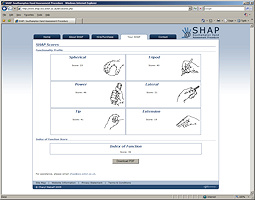
Each SHAP task is independently timed by the participant, ensuring accurate capture of task duration without external influence and recorded on an assessment sheet by the assessor.
Using the method described by Light, Chappell & Kyberd, times can then be normalised to 100 and each of the 26 tasks and is classified within one of the six prehensile patterns. This process generates the SHAP Functionality Profile. In this way, an assessor can generate a quantifiable assessment of hand function that can be broken down into the six prehensile patterns. Therefore, the assessor can then visualise whether a participant has exceptional power and spherical grip, or impaired function in the ability to perform finer manipulations such as tip and tripod grips. In addition, a SHAP Index of Function score can also be generated, which is one number that provides an overall assessment of hand function.
SHAP scores do not plateau at 100, instead scores greater than 100 can be achieved if a participant is exceptionally quick at a given task or series of tasks. Scores less than 100 are an indication of how impaired a participant's hand function is, and whether it is a particular type of grip posture that is causing a lower score.
The SHAP software for generating scores is part of this website, and accessible by purchasing the SHAP.
Important Note: The SHAP is not designed or marketed for use as a diagnostic or therapeutic tool under regulatory definitions such as the Medical Device Regulation (MDR). It is not intended to serve as a substitute for clinical decision-making or treatment planning. Its purpose is to support understanding of hand function through structured task performance, not to determine or influence medical outcomes.
